Bitcoin’s 21 million supply cap is the built-in rule that limits how many bitcoins (BTC) can ever be created, and it’s enforced by the network’s validation rules rather than by any single company or government. The cap emerges from Bitcoin’s issuance schedule: new BTC are minted as part of the block reward, and that “block subsidy” is programmed to halve on a fixed cadence until it effectively reaches zero.
Introduction
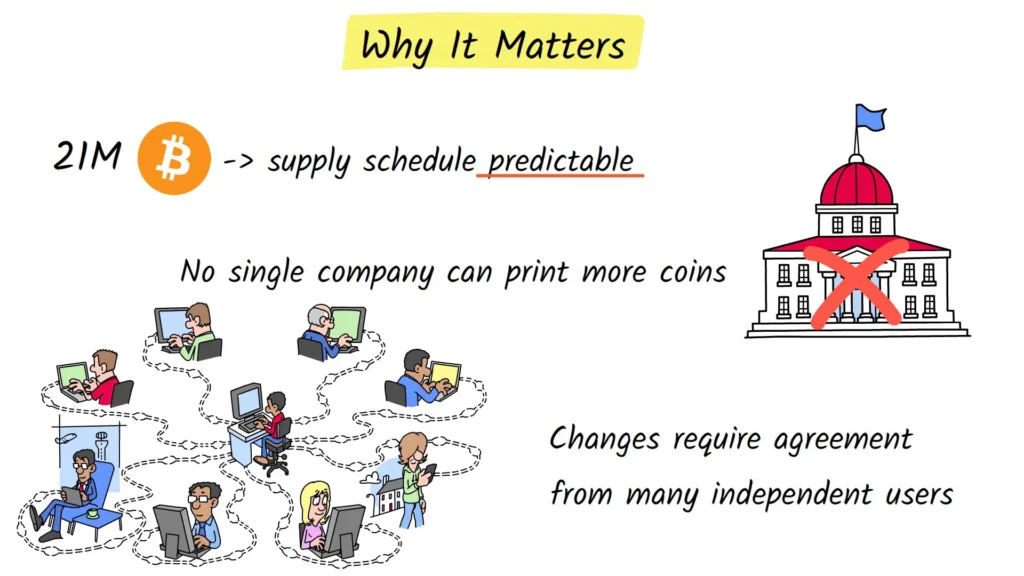
One of the most distinctive Bitcoin design choices is that its money supply is meant to be predictable: the network follows a published issuance schedule, and any participant can verify whether new coins are being created according to the rules. This matters in crypto because many blockchain systems have different monetary policies (fixed supply, capped supply with tail emission, or governance-adjusted issuance), and those differences shape how fees, security, and validation incentives work over time.
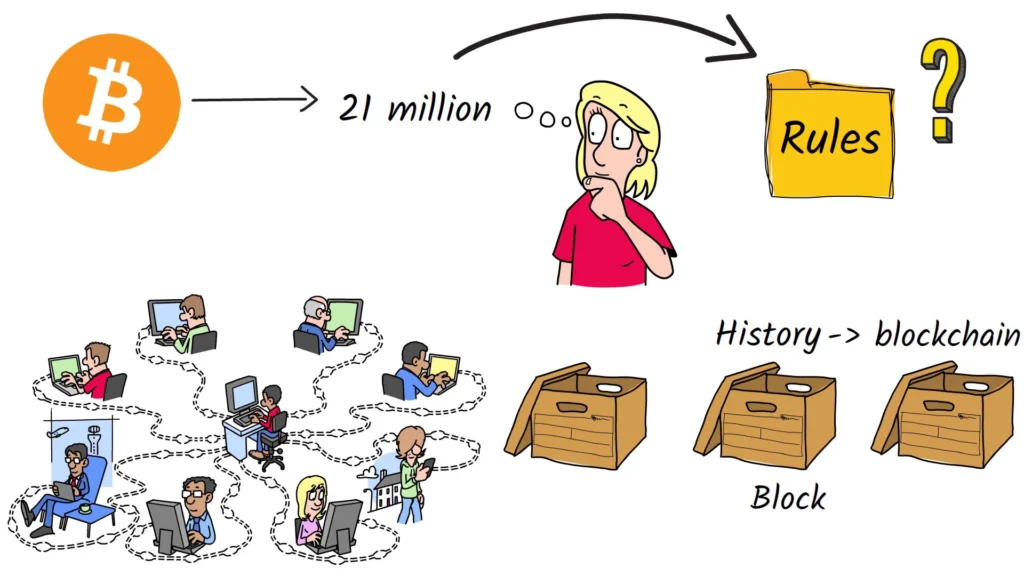
To understand why “21 million” happens, you don’t need to memorize code—you just need to understand how blocks are produced, how miners are compensated, and how the halving schedule mathematically converges on a finite total.
What is the Bitcoin 21 million supply cap?
The Bitcoin 21 million supply cap is the protocol rule that makes the total number of bitcoins asymptotically approach (but never exceed) 21,000,000 BTC as block subsidies shrink over time.
In plain terms: Bitcoin creates new coins on a schedule, and that schedule is designed so the total creation adds up to a fixed maximum.
Featured snippet-style definition:
Bitcoin’s 21 million supply cap is the maximum number of BTC that can ever be issued, enforced by consensus rules that define the block subsidy and reduce it by half at regular block intervals.
If you want to read the original, high-level description of Bitcoin’s design goals and issuance model, Bitcoin.org’s documentation is a good starting point: https://bitcoin.org/en/bitcoin-paper
Why Does the 21 million cap exist? (The Problem It Solves)
Bitcoin needed a practical way to distribute coins early on without relying on a central issuer. In a decentralized system, you also need participants to spend real resources to secure the network and to agree on a single transaction history, even when some participants might be malicious or unreliable.
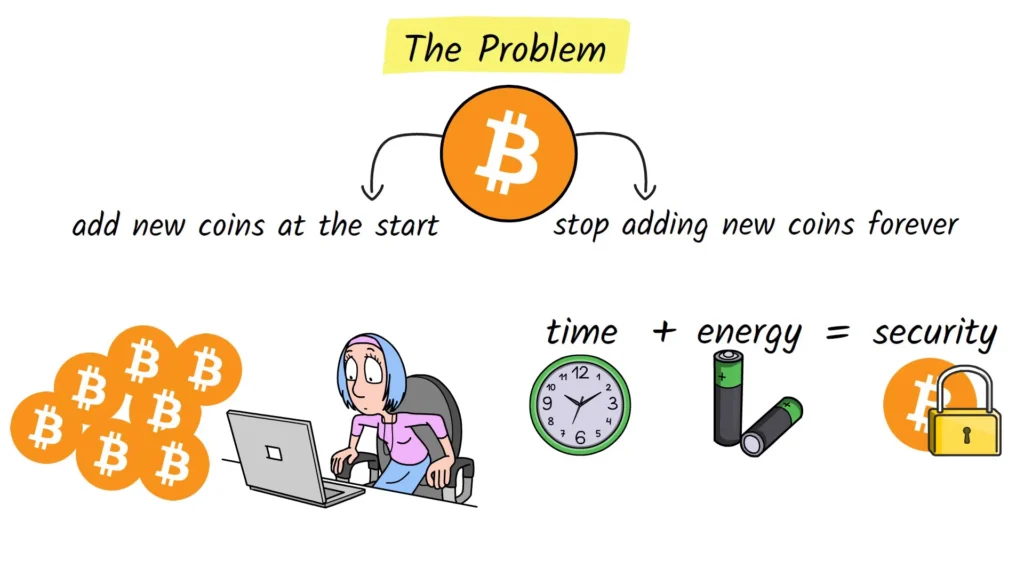
At the same time, Bitcoin’s creator(s) aimed to avoid an issuance process that could expand forever at an unpredictable rate. An unbounded or discretionary supply can make it harder for users to reason about monetary policy, because the rules can change based on an administrator’s preferences rather than on transparent consensus.
In short, the “problem” is threefold:
- How to issue coins without a central mint
- How to pay for network security
- How to make issuance predictable and verifiable by anyone running the software
How the 21 million cap works (Step-by-step explanation)
Bitcoin’s supply cap is not a single “if supply > 21M then stop” switch. Instead, it’s the result of a process that gradually reduces new issuance.
Step 1: Transactions are grouped into blocks
A blockchain is commonly described as a shared, immutable ledger where data is recorded in linked blocks, and each new block reinforces the integrity of the history that came before it. In Bitcoin, a block is basically a package of recent valid transactions plus metadata needed to link it to prior blocks.
Step 2: Miners compete to add the next block (Proof of Work)
Bitcoin uses Proof of Work (PoW), where miners run specialized hardware to search for a valid solution to a cryptographic puzzle. This competitive process determines who earns the right to propose the next block, and it makes rewriting history expensive because you’d need to redo large amounts of work.
More broadly, blockchain networks rely on consensus mechanisms (such as PoW or Proof of Stake) so that nodes can agree on which blocks are valid and which chain is the canonical history.
Step 3: The block reward pays the miner (subsidy + fees)
When a miner produces a valid block, the protocol allows a “coinbase” transaction that pays the miner. That payment has two parts:
- Block subsidy: newly created BTC minted by the protocol
- Transaction fees: BTC paid by users who include fees with their transactions
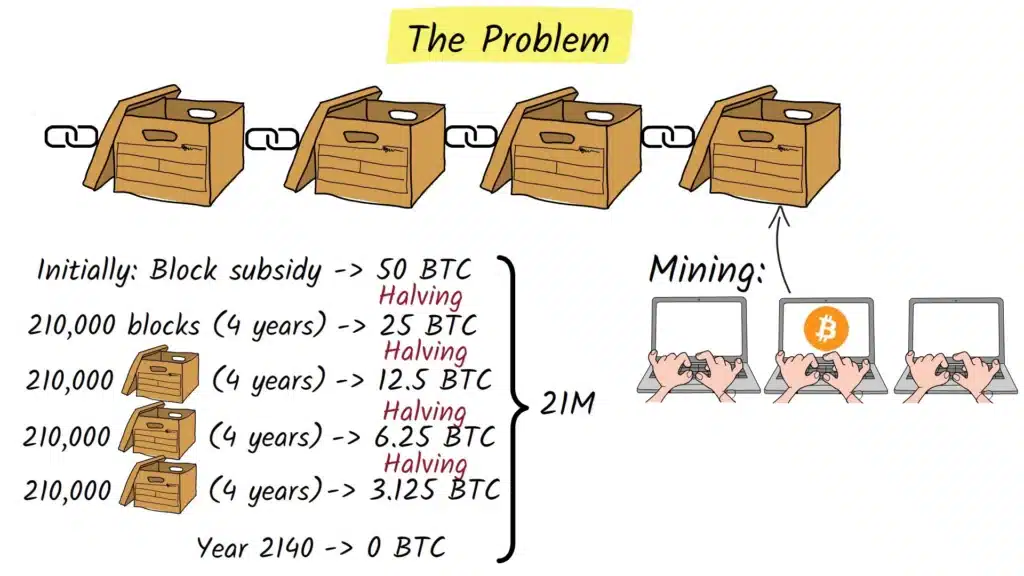
Step 4: The block subsidy halves every 210,000 blocks
Bitcoin’s key issuance rule is the halving: after every 210,000 blocks, the block subsidy is cut in half. Because blocks target an average cadence of about 10 minutes, 210,000 blocks works out to roughly four years (though the exact calendar timing varies).
Historically, the subsidy started at 50 BTC per block, then halved to 25, 12.5, 6.25, and (after the 2024 halving) 3.125 BTC per block.
Step 5: A geometric series converges on a finite total
Here’s the core mechanic behind “21 million”:
- Each halving epoch lasts 210,000 blocks.
- In each epoch, the subsidy is constant.
- When you add up “blocks per epoch × subsidy per block” across all epochs, you get a geometric series:
- Epoch 1 issues: 210,000×50
- Epoch 2 issues: 210,000×25
- Epoch 3 issues: 210,000×12.5
- …and so on
Because each epoch issues half as much as the one before, the total issuance approaches a limit rather than growing without bound. That limit is just under 21 million BTC (with the commonly cited headline number being 21,000,000).
Step 6: Eventually, new issuance effectively stops (around 2140)
As halvings continue, the subsidy becomes so small that it rounds down to zero at the protocol’s smallest unit resolution (satoshis). That’s why people often say Bitcoin’s block subsidy will reach zero around the year 2140—after which miners would be compensated only by transaction fees.
Key components and mechanics
Understanding the 21 million cap is easier if you separate “who enforces rules” from “who earns rewards.”
- Nodes (rule enforcers): Full nodes validate blocks and transactions against consensus rules before accepting them into their local copy of the chain. In general blockchain terms, nodes validate and maintain the ledger through consensus rules so the system stays consistent across many independent participants.
- Miners (block producers): Miners assemble candidate blocks and perform PoW to try to publish the next valid block.
- Consensus rules (the constitution): These rules define validity: block structure, PoW requirements, maximum subsidy, halving schedule, and many other constraints.
- Difficulty adjustment (stability mechanism): Bitcoin periodically adjusts mining difficulty so blocks continue to arrive at a predictable average rate even as total mining power changes.
A helpful way to think about it: miners can propose blocks, but nodes dispose of invalid ones by refusing to accept them.
Incentives and economic design (if applicable)
Bitcoin’s issuance schedule is also an incentive schedule.
- Early years: subsidy-heavy security budget. When Bitcoin was young, transaction volume and fees were low, so the block subsidy did most of the work of paying miners to secure the chain.
- Over time: gradual shift toward fees. As halvings reduce subsidy, transaction fees are expected to become a larger share of miner revenue.
- Why this matters: Network security in PoW depends on miners being paid enough (in aggregate) to devote resources to mining rather than to attacking or abandoning the network.
This incentive design is intentional: subsidy bootstraps security early on, while fee revenue is positioned as the long-run mechanism that could sustain mining after issuance ends. Whether fees alone can provide sufficient security decades from now is an open question that researchers and practitioners debate, because it depends on future transaction demand, fee market dynamics, and competition among miners.
For a general, non-Bitcoin-specific explanation of blockchain systems and how consensus helps keep a shared record consistent, see AWS’s overview of blockchain technology.
Limitations, risks, and tradeoffs
A fixed cap is not “free”—it comes with real tradeoffs and areas of uncertainty.
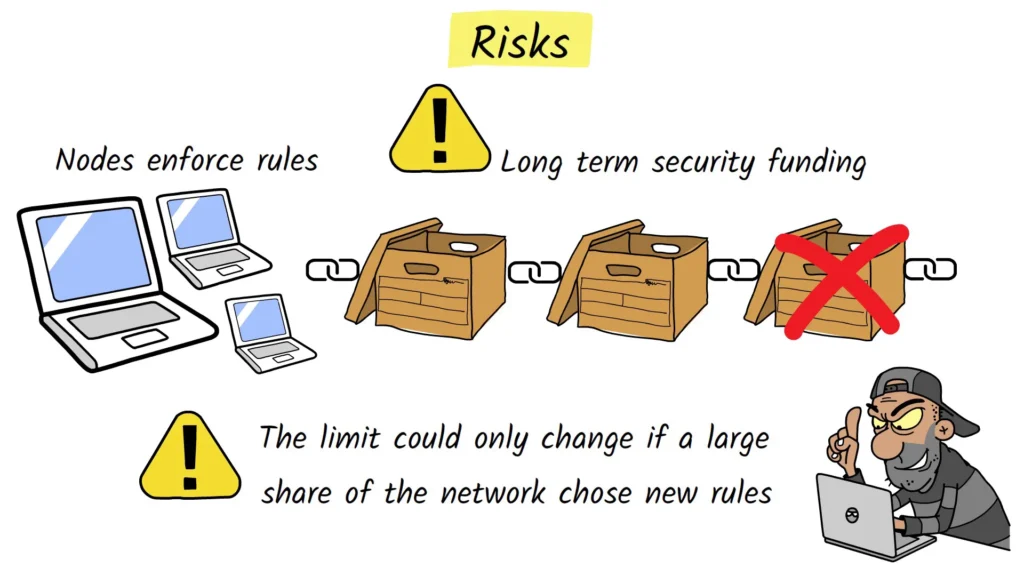
- Rule changes require social coordination. Technically, Bitcoin’s rules are software, and software can be changed—but only if a large share of the ecosystem adopts the change. If different groups adopt different rules, the network can split into incompatible versions (a chain split), creating operational complexity for users and businesses.
- Long-term security budget uncertainty. If block subsidies trend to zero, fees must do more of the work to pay miners. If fee revenue is lower than needed to sustain robust mining, the network could (in theory) become less costly to attack.
- User experience and fee volatility. If Bitcoin is heavily used, fees can rise because block space is limited; if it’s lightly used, fees can be low, potentially affecting miner revenue.
- “21 million” is a headline, not a simple stopping point. The cap is approached gradually; issuance slows down over decades, and small rounding effects exist due to unit granularity.
None of these points imply a forecast about outcomes—they’re simply the engineering and economic tradeoffs that come with a capped, halving-based issuance policy.
Why it matters in the broader crypto ecosystem
Bitcoin’s 21 million supply cap is often discussed as an example of a rules-based monetary policy: the issuance schedule is transparent, precommitted, and verifiable by anyone running a node.
In the broader crypto ecosystem, Bitcoin’s model provides a baseline for comparison:
- Some protocols choose flexible issuance governed by on-chain votes or off-chain governance.
- Others use capped supplies but with different distribution mechanics (premine, treasury, emissions to validators, liquidity mining, etc.).
- Many smart-contract platforms also need to balance issuance with security incentives, whether they use PoW or Proof of Stake.
Even if you never use Bitcoin directly, understanding how the 21 million cap is enforced helps you evaluate other networks’ token issuance rules, validator/miner incentives, and governance tradeoffs more clearly.
Frequently Asked Questions (FAQ)
What rule makes Bitcoin’s 21 million cap happen?
The halving schedule and the maximum allowed block subsidy per block cause new issuance to shrink geometrically, making total supply converge on 21 million BTC.
Can Bitcoin’s 21 million cap be changed?
It could only change if the ecosystem broadly adopted new consensus rules; if adoption is split, it can result in incompatible networks (a chain split).
Who enforces the supply cap: miners or nodes?
Full nodes enforce the rules by rejecting blocks that violate consensus (including invalid subsidies), while miners propose blocks and earn rewards only if their blocks are accepted.
What is the “block subsidy” in Bitcoin?
The block subsidy is the portion of the block reward that creates new BTC according to the protocol’s issuance schedule (separate from transaction fees).
What is the Bitcoin halving, in simple terms?
A halving is the scheduled event where the block subsidy is cut in half every 210,000 blocks, reducing the rate at which new BTC are created.
When will the last bitcoin be mined?
The block subsidy is expected to reach zero around the year 2140, after which miners would rely on transaction fees.
If supply is capped, why do people say Bitcoin issuance “never quite reaches” 21 million?
Because halvings reduce issuance in smaller and smaller steps; mathematically, the series approaches the limit, and practically it ends when the subsidy rounds down to zero at satoshi precision.