Have you ever wondered if there’s a bridge connecting the vast world of blockchains?
Meet Quant, the overledger that rewrites the rules of blockchain connectivity!
Quant, also known by the market ticker QNT, is a type of Distributed Ledger Technology which looks to bring interoperability to the blockchain.
Quant aims to be the backbone that allows for assets of all kinds, from currencies to carbon credits, to be tokenised and sold on the blockchain through their unique, Overledger Operating System.
According to their website, financial institutions, enterprises, and their customers all benefit from assets whose ownership is immutable, provenance is traceable, and use is easier to manage.

But what does that all mean? And how exactly does Overledger work?
Today we find out!
What is Quant?
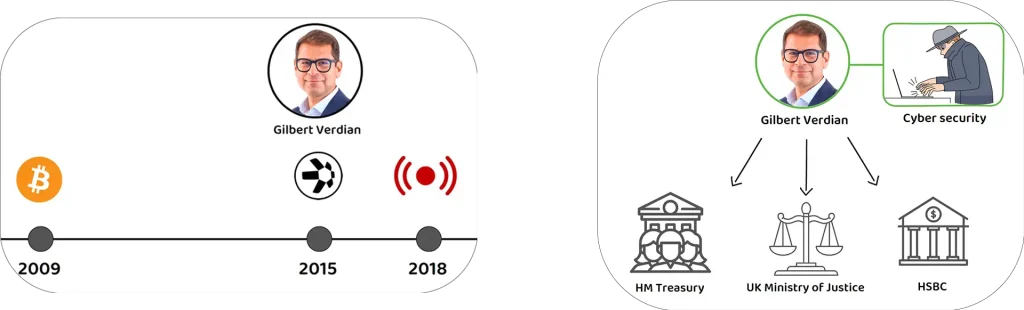
Quant was founded in 2015 by Gilbert, who acts as the CEO with the network going live in 2018.
Gilbert has an interesting cryptocurrency career path having spent most of his time in cyber security-related roles.
This includes working for the HM Treasury – the UK government’s economic and finance ministry, the UK Ministry of Justice, HSBC, etc .. all in various cyber security positions.
It is safe to say he has an extensive career in cyber security, and it was through these roles that Gilbert discovered the potential of Distributed Ledger Technologies, or DLTs.
To quickly explain, a DLT is the consensus of replicated, shared, and synchronised digital data.
While a blockchain is a DLT, not all DLTs are blockchains. But, don’t worry, I will expand upon that point shortly.

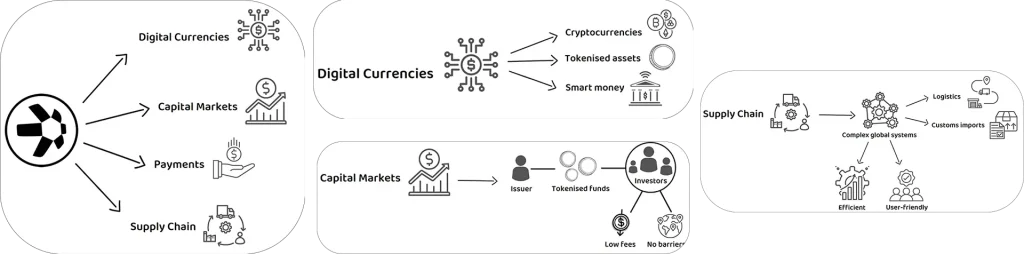
But, back on track, at its core, Quant focuses on four areas: Digital Currencies, Capital Markets, Payments, and the Supply Chain.
To break that down:
Digital Currencies are a combination of cryptocurrencies, tokenised assets, and smart money.
Capital markets in this context are tokenised funds offering the issuer more investors to source money from and offering the users lower fees and no geographical barriers to entry.
Payments are exactly what you expect.
And lastly, the Supply Chain element aims to make notoriously complex global systems more efficient and user-friendly, such as logistics and customs imports.
But, how does this all work?
How Does Quant Work?
As I alluded to, Quant isn’t a blockchain.
It is a type of Distributed Ledger Technology, in this case, referred to as the Overledger.
Quant describes themselves as a blockchain solutions provider, and describes their technology platform as chain-agnostic, meaning not tied to any one particular blockchain or distributed ledger, and as sitting over the blockchain chain ledgers below it, hence the name Overledger.
At its core, the Overledger is a blockchain operating system that allows developers and enterprises to build multi-chain applications.
As the word multi-chain implies, these applications are designed to work across multiple, independent blockchains.

Although DLTs can be used for many applications outside of cryptocurrencies, such as in healthcare or traditional finance, Quant’s Overledger was created specifically as a way to solve the blockchain’s interoperability issues.
What makes Quant unique?
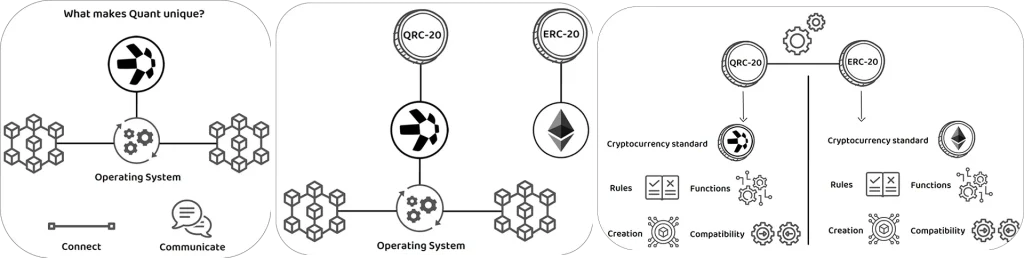
Quant is unique because it is the Operating System, or OS, that allows many blockchains to connect and communicate with each other.
How this works exactly has not been fully released, due to it being proprietary information – meaning it is not based on the work of others, but has been built from the ground up.
Additionally, QNT is a QRC-20 token, which is like Ethereum’s ERC-20 token, but compatible with more networks than just Ethereum.
Although slightly different in name, the QRC-20 and ERC-20 tokens function very similarly to each other.
But, so we’re on the same page, an ERC-20 token is a type of cryptocurrency standard on the Ethereum blockchain, defining a set of rules and functions that enable the creation and compatibility of tokens on the Ethereum network.
QRC-20 tokens do the same thing but for the Quant Overledger.
Meaning that, instead of being a layer 1, such as Ethereum, or a layer 2, Quant is neither.
This is because Quant is the Operating System or OS and the Application Programming Interface, or API, that is built on top of any blockchain to make them compatible with each other, using the QNT token as a measurement of value when trading and for paying the associated network fees.
To clarify, an API is a set of protocols and tools that allows different software applications to communicate and share data, facilitating the integration of functionalities and enabling one program to access and use the services or features of another.
The idea behind the Overledger is to simplify the complexity of blockchains by allowing for a single sign-on experience for apps and payments across multiple blockchains, which will help to lead towards a “one-blockchain” model for consumers, developers, and institutions.

But what about the tokenomics?
QNT Tokenomics
In total, there will only ever be around 14.6 million QNT tokens, all of which are now in circulation.
QNT is mostly used to pay for fees associated with the Quant network, such as accessing the Overledger operating system.
Initially, the token distribution went 68% towards the Public Sale, 18% went to the Reserve, 9% to the Founders, and 5% to the Advisors.
Looking at the blockchain explorer, we can see that no wallet, except for Quant’s own wallet, holds more than 1% of the total QNT supply.
Of course, some sneaky whales could make multiple wallets to hide their true total holdings, but generally speaking, the better distributed the total supply, the less likely one individual will have the power to manipulate the price.

Quant is designed to help blockchains communicate by building a layer on top of them that deals with the conversion of data, between these independent networks.
For cryptocurrencies to go mainstream, for them to become trendy enough for your grandma to get involved with, blockchain technology needs to become more convenient for the average user.
The average person does not want 50 different login accounts, that’s why they all log in with Gmail or Facebook when signing up for new websites.
In theory, this should be good news for projects like Quant which help with the integration of traditional financial institutions and provide a user-friendly all-in-one blockchain experience.
Though, as I’m sure we’re all aware, nothing is ever guaranteed in crypto, of course.